Sunday, May 6, 2018

JUST SOME STUFF

In a previous post about old friends, new friends I forgot to mention this little story, a true story.  While walking on the Meseta, I would see this man who looked familiar.  Not that I thought I knew him, he looked like someone I knew.  I saw him several times while walking and at rest stops along the way.  One evening at an albergue bar, he came in and the only seat available was across the table from me.  I offered him the empty seat.  I was looking at him and again he looked familiar, so I asked him where he was from.  He answered, “Mexico”.  I then asked if he had walked the Camino before, he answered “4 times”. Then I asked, “In 2105?”  He then pointed at me and said, “I had dinner with you in Santiago”.   On the Camino in 2015, Emilio lost his money belt.  My Camino brother Alex found it and was able to return it to him.  The dinner in Santiago was a celebration.  Even on the Camino it is a small world.


One of the readers of the blog sent me a question e-mail.  They asked if walking on the road was dangerous.  In medieval times, it was bandits one worried about, now it’s the odd 18 wheeler or a tractor.  Actually most of the paths and roads we walk are are pretty rural.  Today walking on a local road I only saw 4 or 5 cars in 10 miles.  There are places where you are walking a a busy highway, but they are few and far between.  The worst part about walking on a highway is what the pavement does to your body.  If its hot, your feet are burning, not to mention the stress on one’s joints.


Although, as anywhere, there is some crime, but no more than one would expect at home.  Actually probably less on the Camino.  In 2015, an American woman went missing and was later found murdered.  The perpetrator was caught and convicted.  I have noticed a greater police presence on the Camino this year, with officers patrolling the route both in cars and on bicycles.  The Camino is the lifeblood of some of the communities it passes through and the Spanish Government understands this and has taken steps to make it a safe journey.


The Camino remains crowded and in some towns all the available beds are taken.  I continue to book ahead as it takes the worry out of finding a place to sleep.  Strange, tonight I am in a rural hotel about 300 yards of the Camino in the town of Hospital de Órbigo.  The main part of the town is booked solid, but here I am the only guest.  A room, laundry done, dinner with all the wine I want, and breakfast for 50€.  And they did the laundry. Most pilgrims don’t want to walk any further than they have to.


A THREE STORK TOWN


PILGRIMS DINNER


A DIFFERENT KIND OF PILGRIM


NOW THATS’ A BOCIDILLO 


KICKIN IT IN LEON


Friday, May 4, 2018

CONTINUING ON

ALWAYS TAKE THE SENIC ROUTE


As I write this I am on a day off in the city of Leon.  With a population of around 130,000, it is the largest city in this region.  Many pilgrims take a rest day in here as it is a good place to find whatever a pilgrim needs.  From simple albergues to 5 star hotels.  On my 2015 pilgrimage, I stayed in the upscale Paradore, but alas, it is now closed for renovations, so I’m in a much less expensive 2 star hotel in the historic district.


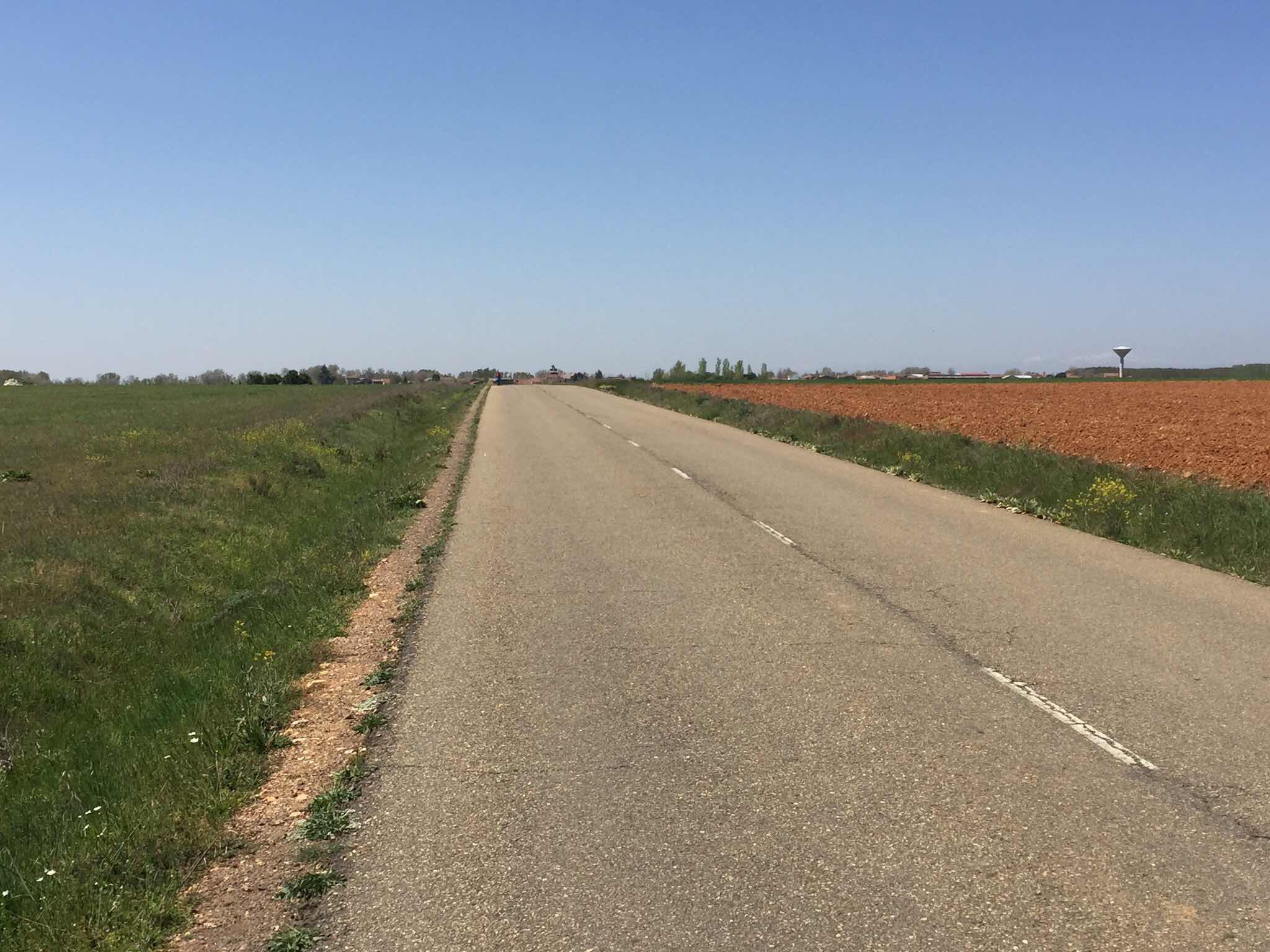
Still on the Meseta which will continue for another 2 days, then the landscape will change with a gradual increase in elevation to the high point on the Camino.  As I have mentioned before, walking the Meseta is not very strenuous in comparison to other sections of the Camino.  Besides being pretty level, the walking surfaces are mostly smooth gravel and dirt roads.  A lot of the time the route follows the highway making it somewhat unpleasant.  There are a few places where the trail splits and you have an option, the most traveled and direct route along the highway, or a less traveled route which rejoin the main trail some kilometers away.  The other day I opted for the less traveled route along the original Camino.  It follows the ancient Roman Road across the flat prairie, with only one town in two days.  The first day, there were fewer but still a significant number of pilgrims.  In the only town, all the beds were taken in the albergue and the pension.  The next day, most pilgrims made a left turn and returned to the more traveled route.  I opted to continue on.  About 15 miles of no towns and few pilgrims.  By the time in the afternoon when I rejoined the main route, I had only seen 4 pilgrims.


LEAVING SAHAGÚN

I HAVE FOUND THIS TO BE TRUE


THE ROAD LESS TRAVELED

The next day on the walk into Leon, it was much the same.  Very few pilgrims and many opted to take the easy way and ride the bus into the city.


LEÓN BELOW

A THREE STORK TOWN

CITY WALLS

The weather as been cooler that normal for this time of year, with morning temperatures hovering around freezing, then warming to the mid 50’s in the afternoons.  Both cloudy and clear skies, with some small amounts of rain.  Add a little wind and it gets cold.  I’ve been wearing my rain jacket over my fleece most mornings to keep warm.  I actually snowed here in Leon last week, a rare occurrence this time of year.


Still going a slower pace than most, but in the towns and villages I sometimes catch up to those I have met before.  Not really a Camino family forming this time, but still plenty of conversation at meal times.  It is a much more solitary journey this time.  Not complaining mind you, as I am enjoying the solitude amongst the hoards.


My feet and body continue to carry me along without too much difficulty.  The other day I developed a small blister on one of my toes, but it is already on the mend.  I am careful to tape up those places on my feet that have developed blisters in the past as a preventive measure and to use lots of Vaseline on them.  Stoping during the day, removing my boots to let my feet air out, reapplying the Vaseline and changing my socks helps tremendously.  I don’t feel like I’m loosing weight, especially with what I’ve been eating, but I’ve only got one more notch on my belt before I need a new one.


JUST ANOTHER PILGRIM


STREET PERFORMER


LEÓN CATHEDRAL 


TAKING IT EASY IN LEÓN 


In 2015 when I walked, most readers know, I met some pilgrims who have become life long friends.  One, Isabel from the Netherlands, who I walked with for the last few days before arriving in Santiago, follows along on the blog.  She sent me a message the other day and said she was going to be in Spain in a city near Leon.  She is in Northern Spain volunteering at a facility that rescues donkeys.  So she hopped on a bus and we met up for lunch.  It was great seeing a fellow pilgrim and catching up on the latest news.


Tuesday, May 1, 2018

WALK, EAT, SLEEP, THE RHYTHM OF THE CAMINO

Walk, eat and sleep, it’s the rhythm of the Camino.  Walking is pretty much self explanatory.  Quality boots or shoes, a comfortable backpack, a layering of clothes for the rise and fall of the temperature.  The terrain changes as does the surface you walk on.  From pavement, to dirt roads, rocky trails, throw an ancient Roman road or two, flat, uphill and down hill, you get the picture.


Sleep is important on the Camino.  You’re tired after a long day of walking.  There are lots of choices for a place to sleep, the most common being an albergue.  Inexpensive and plentiful, sleep on an bunk bed in a room with 6 to 50 of your fellow pilgrims.  Some better than others, with the beds not too close together, others in cramped stuffy rooms with bunk beds pushed up against each other.  You could end up sleeping with a stranger.  There’s plenty to disturb your sleep too.  First comes to mind, the snoring.  There will be snoring and not just by men.  People coughing, tossing and turning, creaky beds,  Then people moving about at all hours, lighting the way with a flashlight or their iPhone.  Don’t forget the farting.  In the morning, the early risers start, stuffing things into their plastic bags and then their pack. Albergue’s run from a from donation up to about 12€.  Some are private and others owned by the town.  You can reserve a bed in the private ones.


Albergues require you to remove your boots and leave them and walking sticks outside the Bunkroom


A place to wash your clothes


Sometimes they fill up


If all else fails, there’s alway outside

I prefer a private a room and some albergues have private rooms for an additional cost.  Pensions, small family run affairs for the most part, with private rooms and bathrooms or a shared bath for a less expensive option.  Running anywhere from 20€ to 40€, they are common in most towns, even the small burgs.  Then there are the Casa Rurals, much like a bed and breakfast, again family owned and in the small towns and in the countryside.  Some are great bargains but others can get quite expensive.  Of course there are hotels, running from inexpensive, 35€ to way up there at over 100€ a night.  There are several Paradores along the Camino, a high end hotel chain owned by the Spanish Government.  Some, but not all, are ensconced in historic buildings which make them a real treat for a break on the Camino.  Running between 100€ to 150€, expensive by Spanish standards, but a real bargain when you consider the price of a 4 or 5 star hotel in the states.


Pension bar


Hotel lobby

The food, ahh the food!  Pilgrims gotta eat and you do build up quite an appetite walking 10 to 15 miles a day.  Most breakfasts, are a simple affair of toast, juice and coffee.  The traditional Spanish toast is spread with puréed tomatoes and olive oil, but most pilgrims opt for butter and jam.  You can order pastries, my favorite being a Chocolate Napoleon or a slice of tortilla, like a quiche, made with eggs, potatoes and onions or even ham and eggs.  The ham being the very thinly sliced Iberian type.  Coffee con leche is the favorite among pilgrims, strong coffee deluded with steamed milk.  Most Albergues serve some kind of limited breakfast.  Bars are the go to place for food on the camino.  Many start walking first thing in the morning, stopping after several hours for something to eat.


Edwardo pours coffee and hot milk (cafe con leche)


Lunch is normally more substantial, with a bocidillo or sandwich. Made with crusty Spanish bread of varying degrees of freshness. You can get just about anything you want in your bocidillo, but don’t expect mayo and mustard.  Usually cheese with some kind of meat or one made with tortilla.  Some of my fellow pilgrims and I have discovered our favorite which is not on any menu.  Cheese, chorizo (Spanish sausage) and a couple of fried eggs.  It is not common, so we have to explain to the cook what we want.  I have received high fives from bar staff when ordering this custom sandwich.  One bar owner said he would put in on the menu, calling it the Bocidillo Espicial Americano.  Costs between 3 and 4€.  There are other choices like salads, soups, pizza and paella.  Beer and wine is the most common beverage for both lunch and dinner.

The Bocidillo Especial Americano
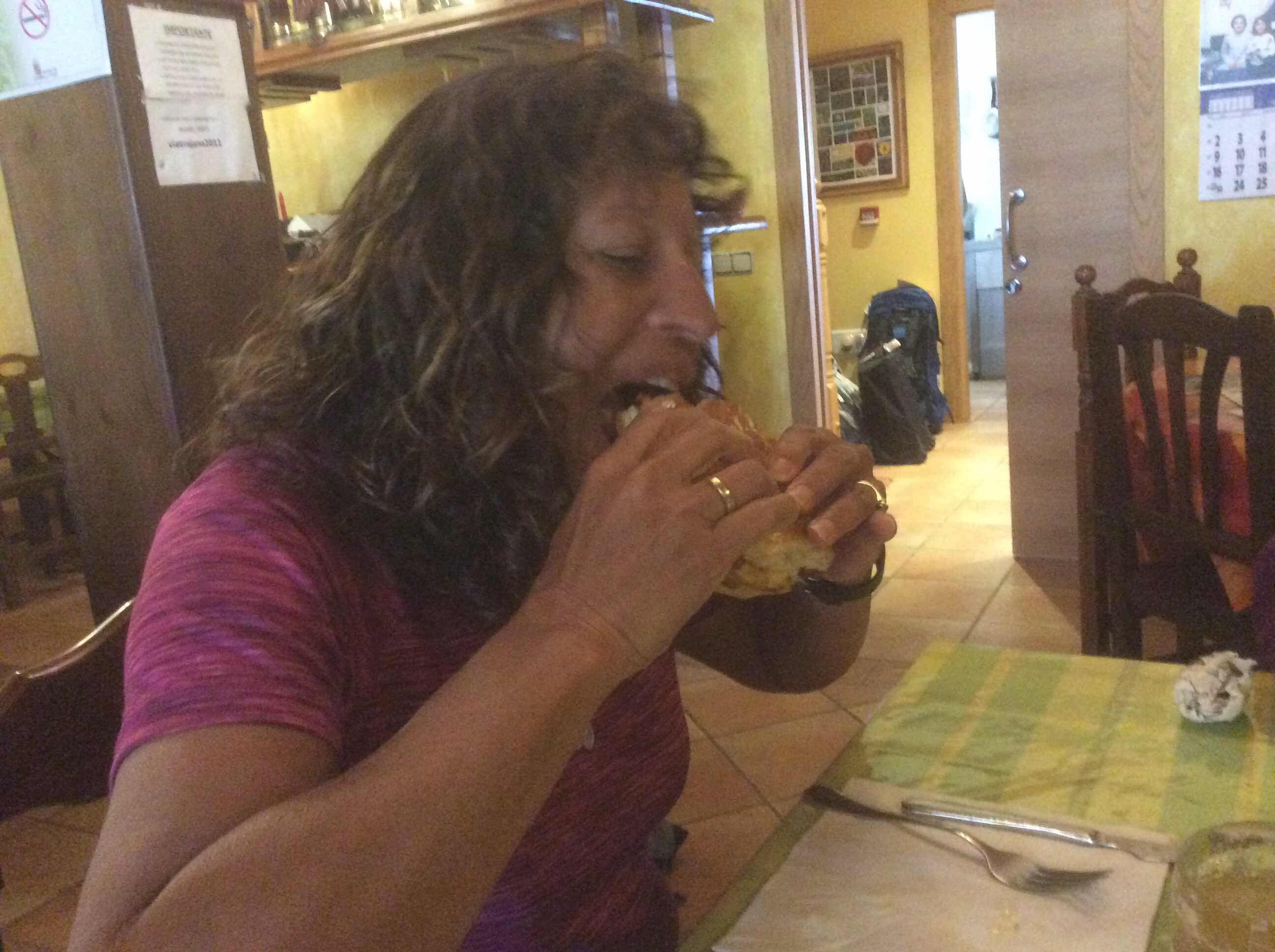

Vicky tries her first

The budget way to go for dinner and some lunches is the Pilgrim’s Menu.  Offered at bars, restaurants and albergues, it normally consists of 3 courses.  A starter, soup, salad, pasta and many other choices. The main course, pork, chicken, fish, paella or what ever the establishment has on hand.  Dinner usually comes with fried potatoes. Then desert.  Commonly offered is a choice of flan, rice pudding, yogurt, sometimes cake is on the menu and almost always ice cream.  The ice cream is of the store bought individually wrapped ice cream bar.  Included in wine or water which tells me that wine is a bargain costing the same as bottled water.  Normally it is a bottle of wine, not a glass. Dinner runs anywhere from 9€ to 13€, unless you go off the pilgrims menu where it can get higher, but you generally have more choices.

Dinner Albergue Style

Ox Tail


There’s always room for ice cream to make a pilgrim smile

There are regional specialties too.  Garlic soup is one choice on the first half of the Camino and later Galician soup consists of vegetables, potatoes and greens.  One specialty I have grown to taste for is Morcilla.  Famous in the Burgos region, it is blood sausage.  Mixed with rice and spices it is sliced and then fried to give it a slight crispness.  I asked for it the other day in Sahagún and was told they were out.  But it appeared with dinner that evening as the owner of the restaurant went out and bought some for me.  Different than the Burgos verity, it is spicer and comes mixed up for spreading on bread.


Morcilla


Sunday, April 29, 2018

THE MESETA

OLD FRIENDS, NEW FRIENDS AND FUTURE FUTURE FRIENDS ALONG THE WAY


It’s mesmerizing in some ways, the Meseta, with it’s straight roads and vivid green fields.  Time seems to slow down as you pass through the towns and villages that the road passes through.  On some days the villages pop up every few miles, offering a place to sit and rest the feet.  Other times, the breaks are fewer and further apart.  Today was a tad over 10 miles with just the fields and the straightness of the road.  You are not alone, far from it, as the Camino seems to be crowed.


A few of the towns have been full at night with no beds available, forcing pilgrims to continue walking to the next town in hopes of finding a bed there.  For me, I continue to reserve a room in advance and have had no problems thus far finding a room.  For some it is the pilgrim way, just to arrive in town and find a bed, but it creates another problem as it becomes a race for beds.  It is said that once we pass Leon, the bed situation Improves with more albergues and other lodging choices.  I will continue to reserve ahead though as I like knowing in advance where I’m staying.


Today is Sunday and it’s a holiday weekend in Spain.  I hasn’t really affected the Camino as cafes, and other establishments catering to pilgrims remain open.  Some are saying that the holiday adds Spanish pilgrims to the Camino with some just walking a few days.


Also today, April 29th I crossed the 200 mile mark.  Not halfway yet but getting closer.  My feet feel pretty good especially after two long days of 15 and 13 miles.  Tomorrow I’ll take it easy and keep it around 10.


Still going slower than most, but in the towns I’m meeting up with other slow people.  Sometimes every night and at other times after several days without seeing them.  I’ll mention some of them here.


Right now across the table from me in the albergue bar is Jack.  A young man from New England who just graduated from high school and is starting college in the next semester.  I sat next to Jack several nights ago at a communal dinner and he related to me his experience with the snorers in the albergues.  As many tend to travel the same speed, one often sleeps in the same bunk room with the same people from night to night.  He told me he can now recognize pilgrims by their snoring.  “Oh, that’s Samuel from Italy just a few bunks away”.


Jeff and Deb, from Connecticut, who I met early on and we’ve shared dinner a couple of times.  They are writing a blog about their Camino.   Steph, from Iowa, who spent the last six years in Cambodia as a Missionary and is deciding what her next calling will be.  Then there’s Linda from Tennessee who is walking across Spain to her Wedding.  At the end of the Camino, she and her fiance have rented a beach front home to be married in.  There is a service here that will move your luggage ahead each day, and that’s what she’s doing with her wedding dress.  Brian and Elizabeth, a retired British couple who divide their home between England and Spain.  They are on a schedule as Brian’s favorite football team is in the finals and they must be home in time for the big game.  As I continue along I will include others who I have met.

Deb and Jeff’s Blog


This is Eduardo one of the hospitaleros at an albergue.  It’s breakfast and he’s serving coffee and hot milk, filling our huge coffee cups.  He’s a blur as he’s moving so fast.


Tomorrow I’ll take a short day, only 10 miles.  One must slow down and let the feet recover after 28 miles the past two days.


Thursday, April 26, 2018

A TOWN, A CITY, THE PLAINS

Everywhere is within walking distance if you have time


First thing out the door when leaving Villafranca Montes de Oca, is a hill.  Not too bad as hills go, but no one wants their first steps to be up hill.  Once at the top it levels out on a broad mesa forested with oaks and pines.  It is foggy so I can’t tell if there are pilgrims ahead of me.  The path becomes broad, a fire break I think, and the walking is easy.  The cool weather helps.  The only stop on this mesa is a small oasis where a woman provides drinks and snacks for a donation.  On this visit I was either to early or she took the day off.  What was there was the art work painted on logs, and the tall sign post pointing the way to various locals around the world.


For some of this time I have been walking with Renee from Texas.  I am sure she is able to walk faster than me, but she slows down and keeps me company for a while.  She is a retired counselor, but continues to provide services to military personnel around the world on a contract basis.  She tells me that once she gets to Burgos the next day, she will be renting a bike and riding across the  Meseta to Leon.  She will do in 4 days what will take me 10.


I stayed in a really nice and kinda funky pension in the village of Atapuerca.  It is here that the remains of early humans have been discovered, some as old as 800,000 years.  There is a museum, but I opted for a boccodillo and a glass of vinto instead.  So I am upstairs in a room with a shared bathroom.  There is no one else to share the bathroom with, so it’s mine.  The place, Pensión El Palomar, is run by Magulana and her husband, who’s name I missed.  Magulana is from Equador and although a great hostess, we all the guests sensed some sadness, as she was missing her family.  They have a bar and a restaurant with the tables all set in fine china.  For dinner the husband dons his chef uniform and retreats to the kitchen.  All the guests on this night are pilgrims and we are treated to a great meal with the wine flowing.  The next morning, Magulana makes us all scrambled eggs and sausage, a rarity for pilgrims.


The next day is Burgos, the Capitol of this region and a city of about 180,000.  Most of the walk on this day is uninteresting.  Starting out, another hill, in the fog, so there are no views.  After a short distance among the green fields, we walk around the perimeter of the Burgos Airport.  Then you have a choice of walking 8 km along the highway into the city or the same distance in a park-like setting along the river.  You know the choice I made, but even so it’s a slog on hard surfaces for the most part.


I’ve been in Burgos a couple of times.  Cathie and I stayed here for a week last year waiting for her leg to heal.  I opted for one night, but most pilgrims take a day off here.  Of course I had to partake in one of the regions specialities, Morcilla sausage.  It’s a blood sausage, but unlike the British version, much nicer.  Besides spices, it contains rice and when cooked the outside becomes crispy.  For dinner I opted for Tapas, as they are plentiful and varied in Burgos.


The next morning bright and early, I head out of the city into the country.  It’s is here that the Meseta starts. The Meseta is a high plateau in Central Spain and it’s fields produce grain crops, most of which are not irrigated.   Primary flat, with some valleys cutting through, it is easy walking for pilgrims.  Many pilgrims dread the vast expanse and either take a bus or train to avoid this section of the Camino.  For me, it is my favorite part of the Camino.  It’s basically flat farm land, but I notice the texture in the landscape with it’s different colors and slightly undulating land.  So for about the next 125 miles it’s easy walking, unless the weather turns bad.


At the starting of the Meseta in the small town of Rabe de las Calzadaz, is a small chapel, the Chapel of Our Lady of the Miraculous Medal.  On my previous walk, this chapel was closed up tight, but today and I believe every day, nuns are there to greet pilgrims.  It is said that Saint Catherine Laboure saw apparitions of the Virgin Mary in the chapel in 1830.  Each pilgrim is given the Medal of the Immaculate or the miraculous medal and given a blessing by one of the nuns.